MOQ, Pricing and Lead Time for Custom Jewelry Box Orders Explained
For B2B buyers, a custom jewelry box order is not judged by unit price alone. MOQ, sample cost, tooling implications, production timing, and shipment planning all affect whether the project is commercially workable.
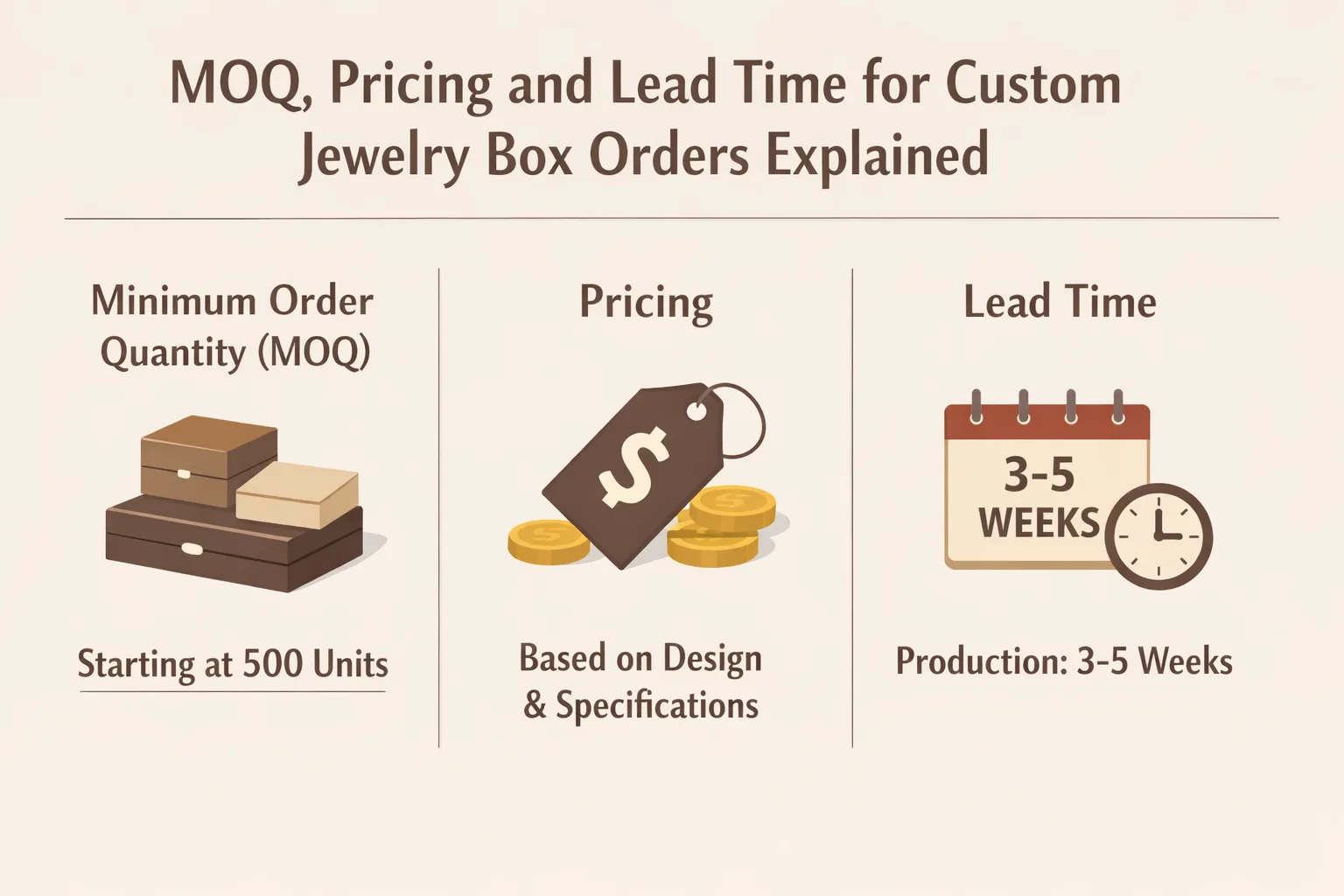
One of the most common questions in custom packaging is simple: What is the MOQ, how much will it cost, and how long will it take? But in real B2B sourcing, those three questions are closely connected. A lower MOQ may raise the unit cost. A more premium logo finish may extend the lead time. A complex insert may affect both price and production planning. This is why buyers should evaluate custom jewelry box MOQ, pricing, and lead time as one decision framework rather than three separate topics.
Many packaging projects run into trouble because buyers compare quotations too quickly. One supplier may quote a lower price but omit protective packing assumptions. Another may promise fast delivery without clarifying whether the timing includes sampling, approval, and export packing. A third may offer a workable MOQ but only on a simplified material or structure. None of those offers can be judged correctly without understanding the logic behind them.
This guide explains what affects custom jewelry box pricing, why MOQ varies, what makes lead times longer or shorter, and how B2B buyers can compare offers in a more professional way. If you are still evaluating suppliers, start with our custom jewelry box supplier guide. If you want to avoid mismatch between approved samples and bulk orders, also review sample vs mass production. For shipment protection planning, see protective packaging for jewelry boxes.
TL;DR: What B2B Buyers Need to Know First
- MOQ, pricing, and lead time are connected. Changing one often affects the other two.
- The main price drivers are material, box structure, logo finish, insert complexity, quantity, and packing method.
- MOQ is usually based on production efficiency, material usage, and process setup, not an arbitrary number.
- Lead time should include sampling, approval, production, packing, and shipping preparation, not only factory production days.
- The best quotation is not always the lowest one. Buyers should compare total execution value, consistency risk, and delivery reliability.
Why MOQ, Pricing and Lead Time Must Be Evaluated Together
In B2B jewelry packaging, buyers often ask for MOQ, price, and lead time in the same email because these three factors directly shape the commercial feasibility of the project. A packaging concept may look attractive, but if the MOQ is too high for a test launch, or if the lead time is too long for a seasonal collection, the offer may not be practical. Likewise, a quotation that appears economical can become risky if it is based on simplified materials, weaker inserts, or insufficient transit protection.
Professional buyers therefore compare offers by total order logic. They ask whether the MOQ aligns with inventory planning, whether the quoted cost reflects the real packaging specification, and whether the lead time fits launch or replenishment needs. This approach is more reliable than focusing on a single unit price.
What Affects MOQ for Custom Jewelry Boxes
MOQ is often misunderstood as a rigid factory policy, but in most cases it is driven by production efficiency. Suppliers set minimum order quantities based on how efficiently they can run materials, tools, finishing processes, insert production, and packing lines.
1. Box Structure Complexity
Simple rigid boxes, drawer boxes, magnetic closure boxes, lift-off lid boxes, and multi-piece gift sets do not consume the same amount of setup time or labor. More complex structures often require a higher MOQ to make production economical.
2. Material Selection
Special wrap materials, custom textures, premium lining fabrics, and limited-availability finishes may require larger material commitments. That can affect MOQ even before the box is assembled.
3. Logo Process
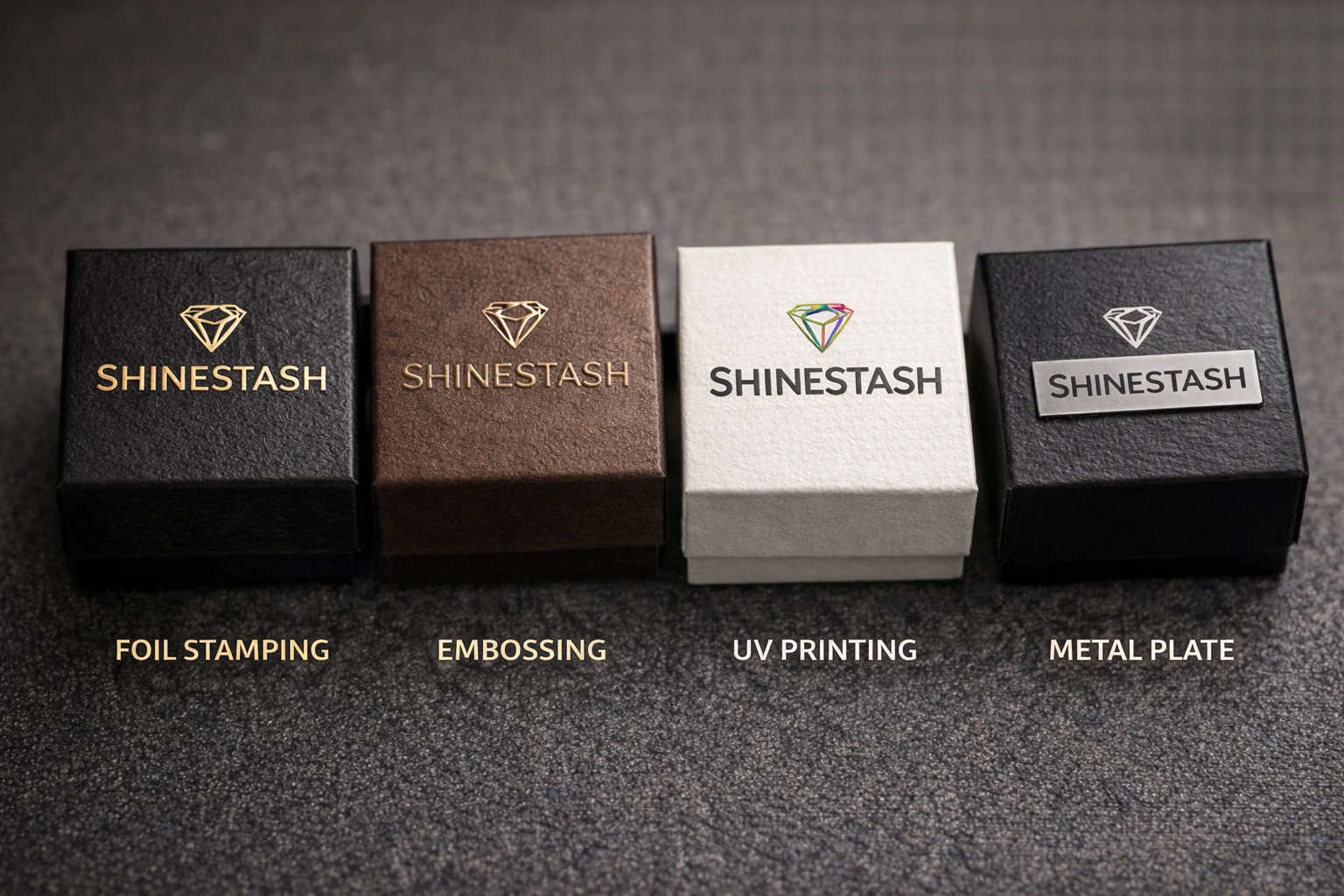
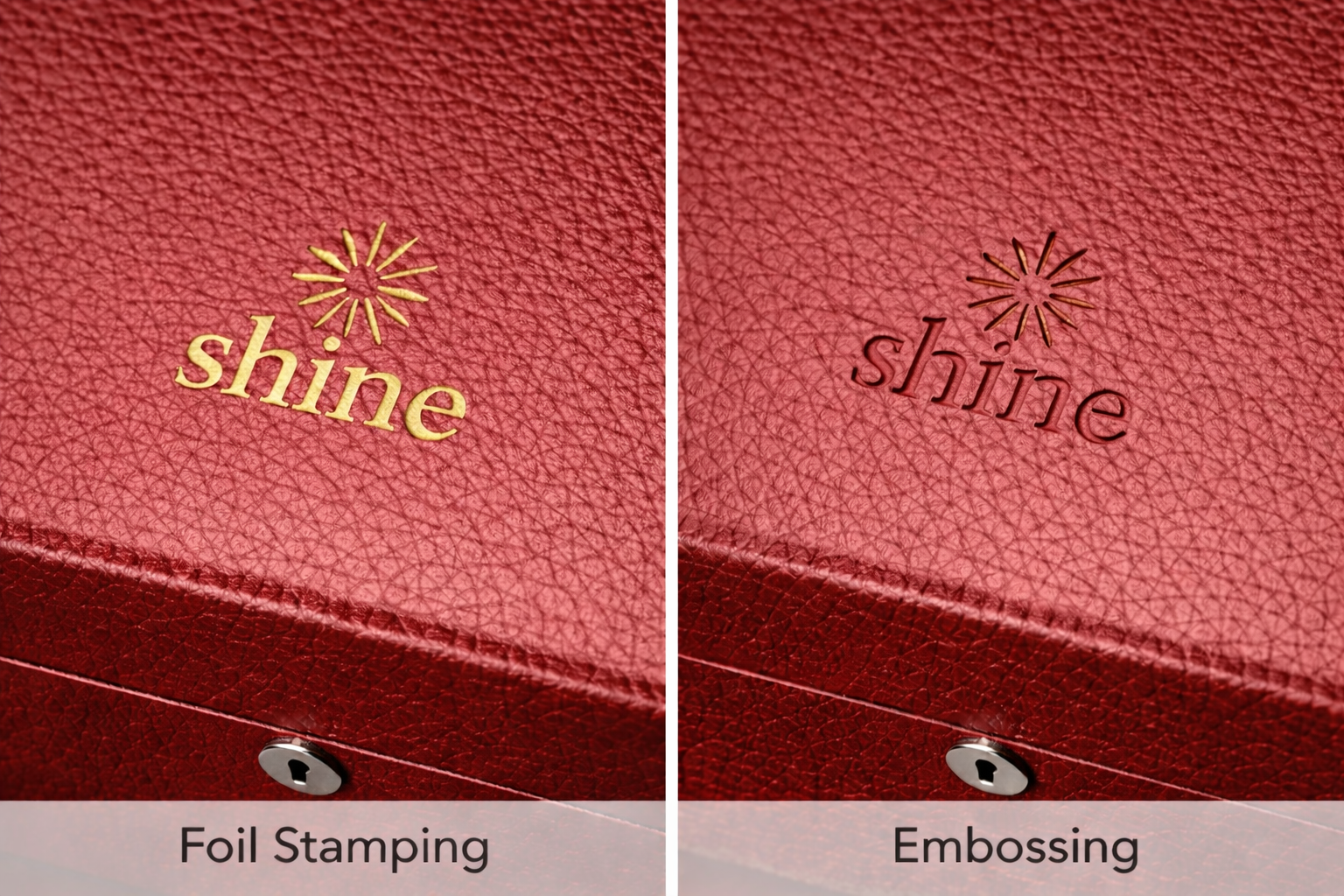
Foil stamping, embossing, debossing, UV, and metal logo plates each involve different setup logic. Some options are more suitable for short runs, while others become more efficient at larger volumes. For finish-specific planning, see our logo finishes guide.
4. Insert Design
Standard inserts usually allow more flexibility than custom-fit inserts for rings, necklaces, bracelets, or sets. The more product-specific the insert, the more MOQ may be shaped by cutting, lining, and assembly efficiency.
5. Quantity Planning Across SKUs
A buyer may need several box sizes or multiple jewelry categories at once. MOQ should be reviewed not only per style, but also per color, size, insert version, and logo variation, because each variation can create a separate production threshold.
6. Packing and Shipment Requirements
Premium protection, export carton rules, and anti-rub packing methods can also affect practical MOQ, especially when the order is small and packing cost becomes a larger share of the total.
Why MOQ Can Differ Between Suppliers
Different suppliers have different machinery, material sourcing habits, labor structures, and process efficiencies. That is why one supplier may accept a lower MOQ on a certain jewelry box format while another prefers a larger run. Buyers should not assume that MOQ differences mean one supplier is unreasonable. They often reflect different production systems.
When a Lower MOQ May Not Be Better
A very low MOQ can look attractive during the quoting stage, especially for test orders or new product launches. However, buyers should check whether that lower MOQ comes with higher unit cost, reduced customization options, simplified inserts, or longer replenishment risk later. MOQ flexibility is useful, but it should still support the brand’s packaging goals.
What Affects Pricing
B2B buyers should view custom jewelry box pricing as the result of multiple packaging decisions rather than a standalone price tag. Two boxes that look similar in a photo may differ significantly in internal structure, material feel, logo finish, and protective packing cost.
Material Quality and Surface Finish
Outer wrap materials, textured paper, PU, velvet, satin, lining fabric, and board thickness all influence cost. A packaging project that aims for a more premium look and tactile feel will usually cost more than a basic version, even if the external dimensions are similar.
Logo Decoration
Logo finishing is one of the most visible cost variables. Different finishes involve different setup steps, equipment behavior, and yield control. Buyers should compare not only appearance, but also whether the finish aligns with the brand positioning and order volume.
Insert Complexity
Inserts affect both function and cost. A standard ring slit, a necklace card system, a bracelet support platform, or a fitted gift set insert each require different materials and labor intensity. For structure planning, read the jewelry box insert structure guide.
Box Construction
Lid-and-base boxes, magnetic boxes, drawer boxes, hinged boxes, and premium set boxes do not share the same cost structure. The more parts, finishing points, or alignment-sensitive elements involved, the more pricing tends to rise.
Quantity Scale
Larger quantities usually improve cost efficiency because setup cost, tooling preparation, and material planning are spread across more units. That does not always mean the buyer should order more than needed, but it explains why quotations shift with quantity.
Packing Method and Protection
Unit bags, tissue protection, surface protection, dividers, corner protection, and export carton design all affect the total. Buyers who compare quotations fairly should confirm whether protective packing is included, especially for cross-border orders. Related: protective packaging for jewelry boxes.
Sample Cost vs Bulk Cost
A sample is not priced the same way as a production run. It includes setup attention, manual adjustment, and smaller material usage. Buyers should therefore avoid using sample price as a benchmark for unit production cost. The two serve different commercial functions.
What Buyers Should Not Do When Comparing Price
Do Not Compare Incomplete Specifications
If one quotation includes a custom insert, better wrap material, and export-grade packing while another does not, the lower price does not necessarily represent better value. The specifications must be aligned before the comparison is meaningful.
Do Not Ignore Risk Cost
A cheaper box that arrives with poor logo quality, inconsistent wrapping, weak insert support, or transit damage may create more cost later through rework, complaint handling, or delayed launches. Total sourcing value matters more than the cheapest number on the first page.
Do Not Separate Price from Lead Time
Some buyers accept a very attractive quotation without checking whether the production timing is actually compatible with their calendar. If the order misses a collection launch, promotion period, or replenishment window, the initial savings may not matter.
What Affects Lead Time
Custom jewelry box lead time depends on more than factory output days. For B2B buyers, the real schedule usually includes inquiry clarification, quotation confirmation, artwork approval, sample development, sample review, bulk production, inspection, and packing preparation.
1. Sampling and Approval Stage
Lead time starts long before the first bulk unit is produced. If a project involves custom sizing, non-standard inserts, or branded finishing, the sample and revision stage can shape the final schedule heavily.
2. Material Readiness
Standard materials may be available quickly, while special textures, specific colors, or custom components can require more coordination. This affects the production calendar even if the box structure itself is simple.
3. Order Complexity
A single-SKU order with a straightforward insert is usually easier to schedule than a multi-SKU order with multiple inserts, multiple logo versions, or matching accessory packaging.
4. Production Load and Seasonality
Lead time can shift depending on factory capacity, holiday periods, high-demand seasons, and queue position. Buyers should ask whether the quoted timing reflects the current load realistically.
5. Packing and Final Inspection
Export-ready packing and final QC are part of the real lead time. A supplier who only quotes manufacturing days may leave buyers exposed to hidden schedule extensions later.
6. Revision Risk
Unclear approval, late artwork changes, or unconfirmed insert adjustments often create more delay than the factory run itself. Good pre-production control shortens the total timeline.
What a Realistic Lead Time Should Cover
Buyers should ask whether the quotation covers sample development, revision cycles if necessary, production scheduling, logo preparation, insert confirmation, finished goods inspection, and export packing. Without that level of clarity, lead time comparisons between suppliers can be misleading.
Why Fast Is Not Always Better
An unusually short lead time may sound efficient, but it can also signal that key steps are being excluded from the quotation, or that the supplier is oversimplifying the process to win the order. Speed is valuable only when it does not compromise consistency, packaging protection, or approval quality.
How to Compare Supplier Quotes Properly
The most professional way to compare B2B jewelry packaging quotations is to review them line by line against the same packaging brief. Buyers should compare structure, material, insert, logo finish, MOQ logic, packing assumptions, and lead time scope together.
Check Specification Alignment First
Before comparing numbers, confirm that each supplier is quoting the same box type, dimensions, wrap material level, insert structure, logo finish, and packing method. Otherwise, the quotations are not truly comparable.
Ask What Is Included and What Is Not
Clarify whether the quotation includes sample cost, tooling preparation where applicable, logo plate preparation, export packing, and inspection. A lower quote may simply exclude items another supplier has already included.
Review Timing Logic, Not Just Delivery Promise
Ask how the schedule is built. Does it start after sample approval? Does it include packing? Does it reflect current capacity? Buyers should not judge lead time by a single optimistic sentence.
Balance MOQ Against Inventory Risk
A larger MOQ may improve cost efficiency but increase stock pressure. A smaller MOQ may reduce upfront commitment but lift cost per unit. The right decision depends on launch stage, reorder confidence, SKU variety, and cash-flow priorities.
Buyer Checklist Before Order Confirmation
Use the checklist below before approving a custom jewelry box order. It will help you judge whether the quoted MOQ, price, and lead time are workable for the actual project.
| Checkpoint | What to Confirm | Why It Matters |
|---|---|---|
| MOQ Basis | Is MOQ set by structure, material, insert, logo process, or color/SKU split? | Helps avoid surprise quantity limitations later |
| Box Specification | Are structure, size, wrap material, lining, and insert clearly defined? | Prevents price comparisons based on mismatched specs |
| Logo Finish | Is the exact logo method and visual standard confirmed? | Logo treatment affects both cost and perceived value |
| Sample Cost | Is sample pricing separated from bulk unit pricing? | Avoids confusion between prototype cost and production cost |
| Bulk Price Logic | Does the quoted price change by quantity tier or variation count? | Supports better order planning and forecasting |
| Lead Time Scope | Does it include sample approval, production, inspection, and packing? | Improves schedule realism |
| Packing Standard | What unit and carton protection is included? | Transit protection can affect total cost and arrival quality |
| Revision Risk | What happens if artwork, insert fit, or material details change? | Late changes can affect both cost and timing |
| Consistency Support | How will the approved sample be linked to bulk production? | Reduces mismatch risk between prototype and full order |
| Supplier Capacity | Can the supplier support repeat orders or scale-up demand? | Important for long-term B2B packaging planning |
How MOQ, Pricing and Lead Time Fit into Supplier Evaluation
Buyers should not evaluate MOQ, price, and timing in isolation. A supplier who offers a workable MOQ but cannot maintain quality consistency may still be a poor fit. Likewise, a competitive price is less valuable if the factory cannot control sample-to-bulk repeatability or shipment protection. That is why this article should be used together with supplier screening and production control pages, not as a standalone costing sheet.
If a quotation looks promising, the next step is to confirm how that supplier handles approval standards, bulk consistency, and inspection logic. You can cross-check those areas in our sample vs mass production guide and quality control guide.
Related Guides
Use these pages together to make stronger B2B packaging decisions:
- How to Choose a Reliable Custom Jewelry Box Supplier for B2B Brands
- Sample vs Mass Production: How to Keep Custom Jewelry Box Orders Consistent
- How to Evaluate Quality Control in Bulk Jewelry Box Manufacturing
- How Logo Finishes Affect the Perceived Value of Custom Jewelry Boxes
- How to Choose the Right Insert Structure for Rings, Necklaces and Bracelets
- How Protective Packaging for Jewelry Boxes Reduces Shipping Damage
Final Thoughts
A workable packaging order is built on balance. MOQ must fit inventory reality, pricing must reflect the real packaging specification, and lead time must support the business calendar. When one of those three is misunderstood, the whole sourcing decision becomes weaker.
For B2B jewelry brands, the most useful quotation is the one that is commercially realistic, production-aware, and clearly structured. That is the quotation most likely to become a dependable long-term packaging solution rather than a one-time cost comparison exercise.
FAQ
What affects MOQ for custom jewelry boxes?
MOQ is usually influenced by box structure, material choice, logo process, insert design, SKU variation count, and packing requirements. It is often based on production efficiency rather than a random number.
Why can one supplier quote a lower MOQ than another?
Different suppliers have different production systems, machinery, sourcing habits, labor structures, and process efficiencies. A lower MOQ may reflect a different operating model, not necessarily a better or worse supplier.
What affects custom jewelry box pricing the most?
The biggest pricing factors are material quality, box construction, logo finish, insert complexity, quantity scale, and protective packing requirements. Sample pricing and bulk pricing should also be treated separately.
What should lead time include in a B2B packaging order?
Lead time should include sample development, approval, production scheduling, manufacturing, inspection, and packing preparation. Buyers should not rely on a simple factory production estimate alone.
Should buyers always choose the lowest quotation?
Not necessarily. The lowest quote may exclude protective packing, simplify materials, weaken inserts, or hide timing risks. Buyers should compare total execution value, not only the headline price.
Need a Better Way to Review Packaging Quotes?
Use this page as a commercial checklist before approving quantity, price, and timing. Then compare supplier capability, sample-to-bulk consistency, and quality control standards together so the quotation supports real execution, not just a lower number.