Custom Jewelry Box Logo Cost, MOQ & Lead Time Explained
A B2B buyer’s guide to plan packaging budgets, avoid rework, and keep bulk reorders consistent.
For B2B buyers, the real cost of “a logo on a jewelry box” isn’t just the printing step — it’s the combination of finish method, material compatibility, tooling, and how stable your SKU will be across reorders.
This page explains the most important factors that affect logo cost, how to estimate a realistic MOQ, and how to plan lead time (sampling → PPS → mass production) with fewer surprises.
TL;DR — Fast Planning Rules
- Most predictable premium option: foil or deboss + foil on stable SKUs.
- MOQ is driven by: box structure + material + finish + whether you need new tooling.
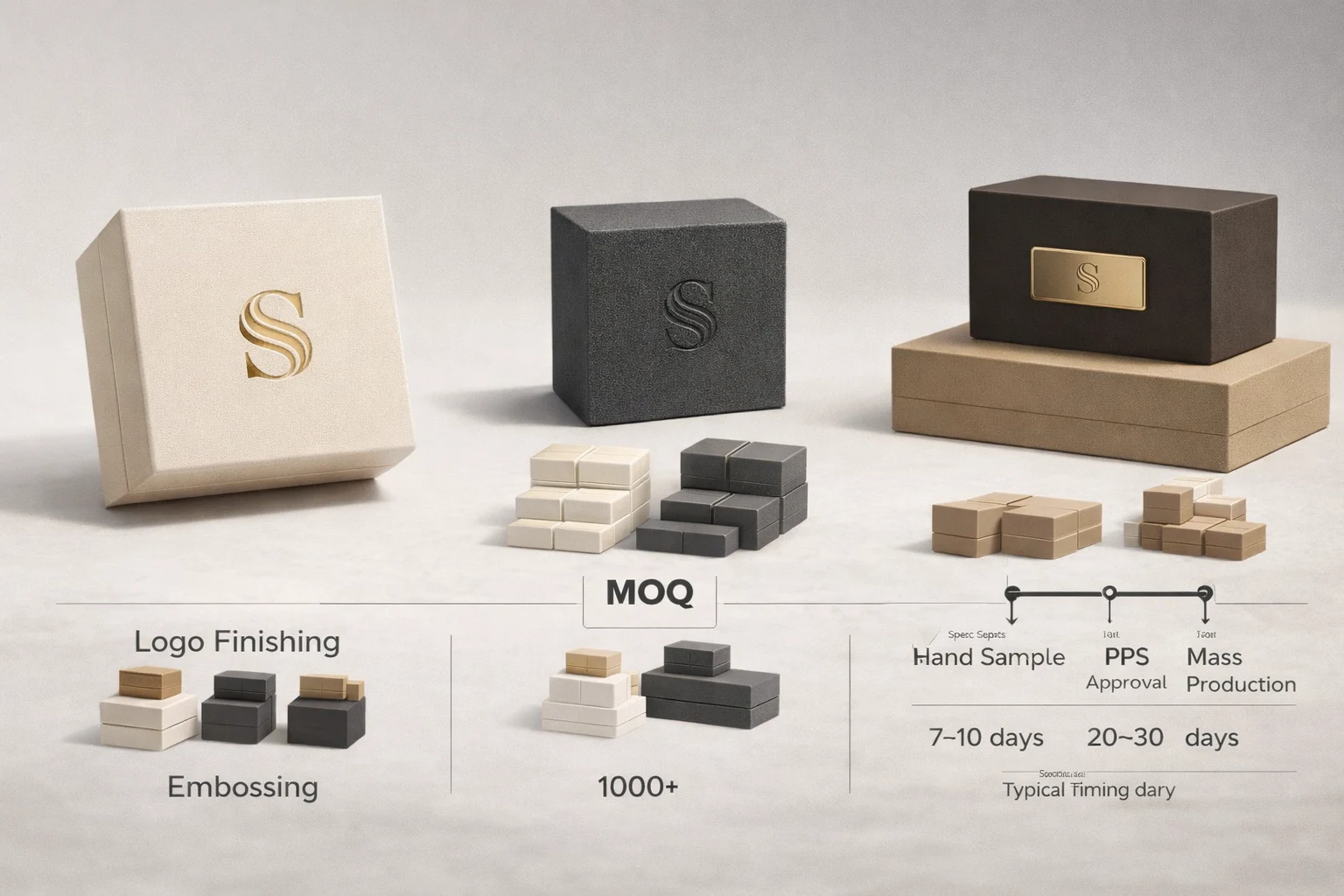
- Sampling timeline: 7–10 days hand sample after specs confirmed (photo/video confirmation available).
- Mass production: typically 20–30 days after PPS approval.
- Fastest way to reduce delays: send a clean RFQ with size, qty, material, finish, and artwork (vector preferred).
What Affects Logo Cost on Custom Jewelry Boxes?
Logo cost is not a single number — it’s a bundle of decisions. The same logo can be low-cost on one material and high-risk on another.
| Cost Driver | Why It Matters | How to Keep It Efficient |
|---|---|---|
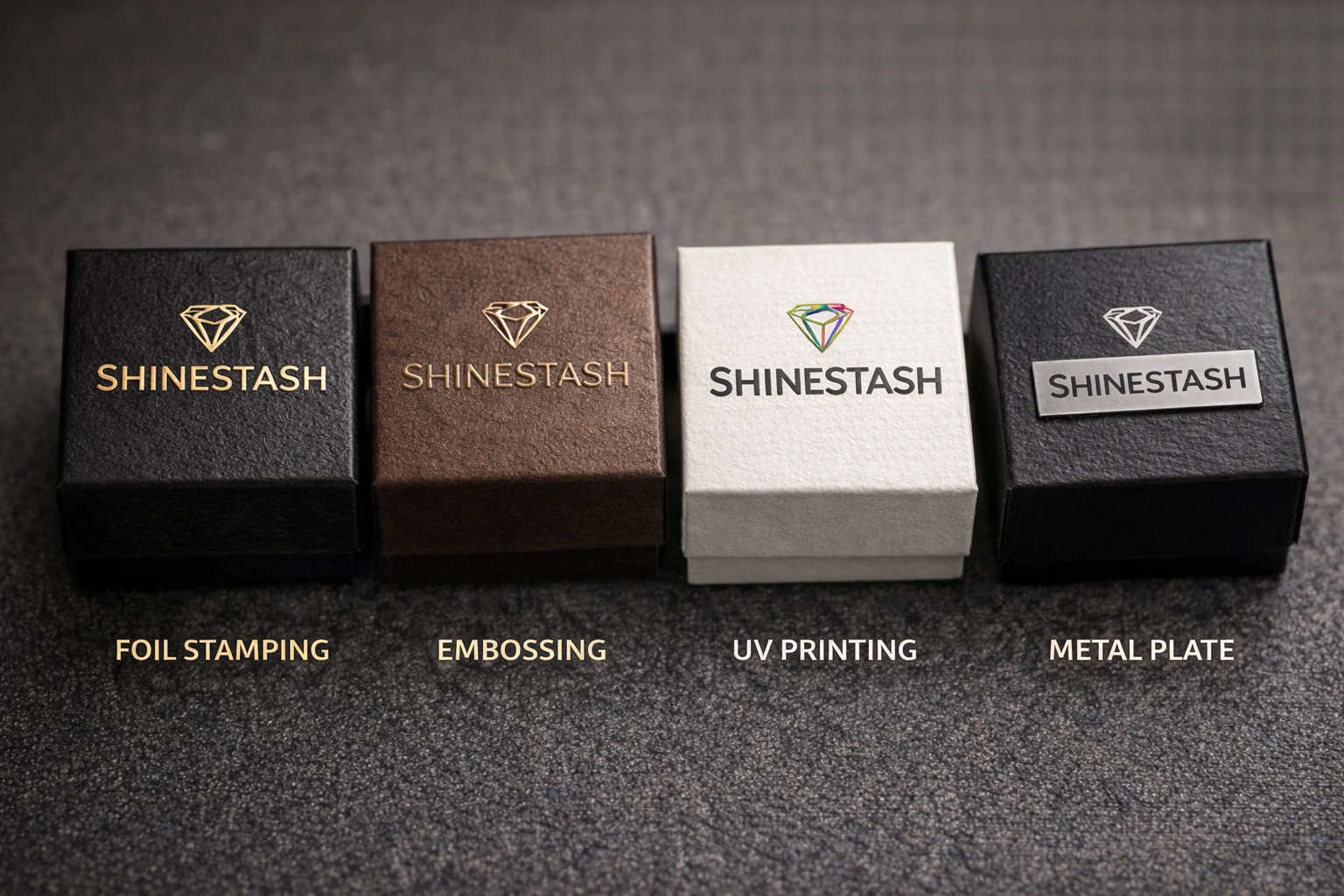
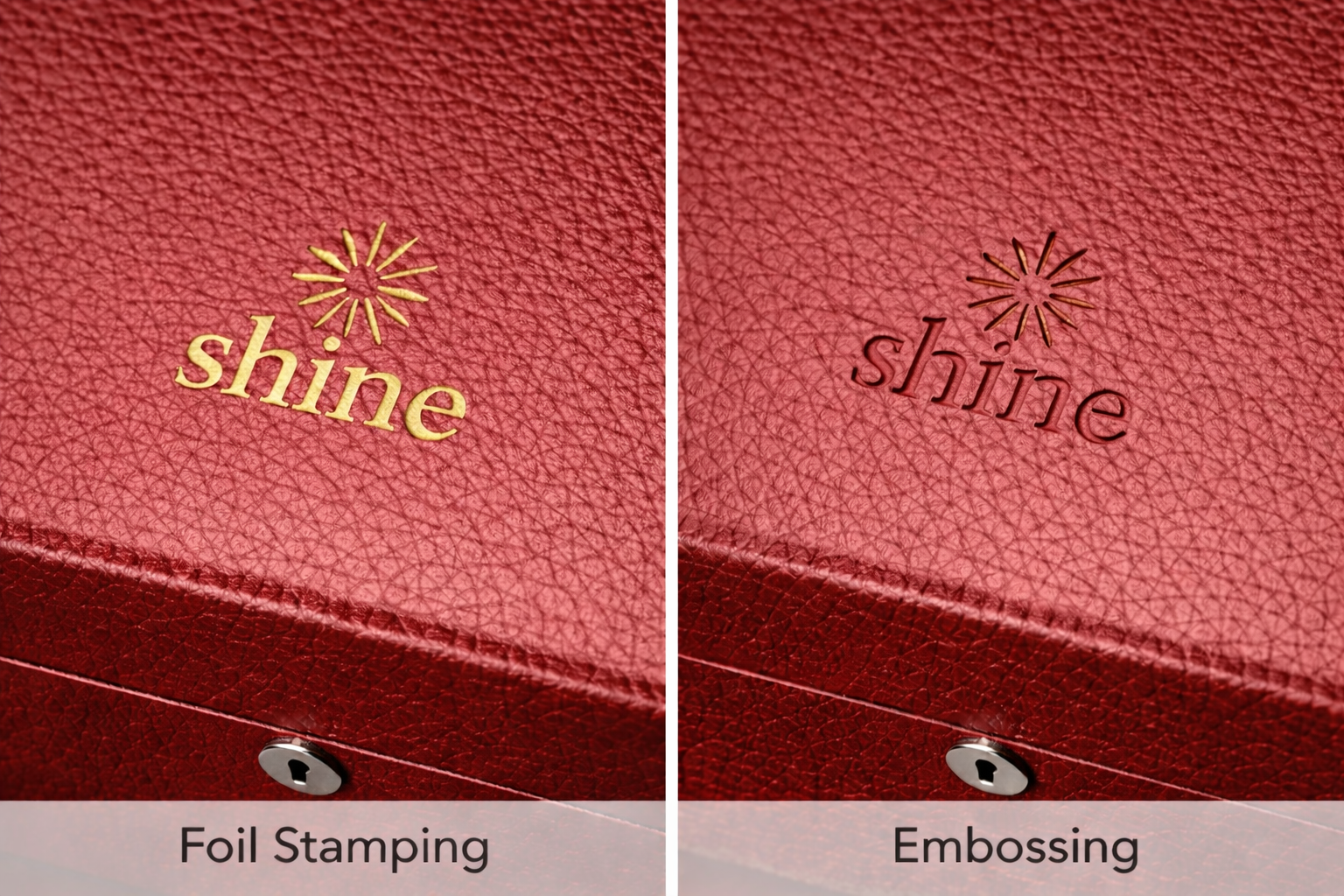
| Finish method (foil / emboss / UV / screen / plate) | Different processes require different setup, tooling, and QC. | Use a finish aligned with your brand style and SKU stability. For premium baseline, foil is often the most scalable. |
| Tooling (dies, plates, molds) | Some finishes require custom tooling; changes later create rework. | Lock artwork early. Avoid frequent logo updates for long-term SKUs. |
| Artwork complexity | Ultra-thin lines, tiny text, and gradients increase failure risk and sampling loops. | Provide vector files (AI/EPS/PDF). Avoid hairline strokes on textured paper. |
| Material compatibility | Surface texture and coatings affect adhesion and edge clarity. | Check materials & craft compatibility before finalizing a finish. |
| QC requirements | Retail handling and shipping friction can expose weaknesses. | Confirm key checks (rub/adhesion) and review durability testing. |
MOQ: How Factories Actually Set It
MOQ (minimum order quantity) is usually set to cover setup time, material utilization, and production efficiency — not just “because the factory wants more.”
MOQ rises when…
- Structure is complex (multi-layer inserts, special hardware)
- Finish requires tooling and strict QC
- Material is custom-dyed or special-coated
- Multiple SKUs share small quantities
MOQ can be lower when…
- Using standard sizes with logo customization
- Stable materials and finishes are selected
- Artwork and specs are locked early
- Single SKU volume is consolidated
Lead Time: Sample → PPS → Mass Production
Lead time depends on how quickly specs are confirmed and how many revision loops happen during sampling. Here’s a realistic planning timeline for B2B orders:
| Stage | What Happens | Typical Timing |
|---|---|---|
| Specs confirmation | Box size, structure, material, insert, logo finish, and artwork are locked. | Depends on your inputs (faster with a clear RFQ) |
| Hand sample | Handmade sample for appearance and structure confirmation (photo/video confirmation available). | 7–10 days after specs confirmed |
| PPS sample | Pre-production sample to confirm mass production consistency (finish, color, fit, QC). | After hand sample approval (varies by project) |
| Mass production | Production starts after PPS approval; includes QC and packing. | 20–30 days after PPS approval |
Trade terms supported: EXW / FOB / CIF (project-dependent). Final timing depends on spec complexity, material availability, and approval speed.
How to Lower Cost & Timeline Risk
- Lock the finish early: avoid changing foil color/emboss depth after sampling begins.
- Keep artwork production-friendly: vector preferred; avoid ultra-thin strokes on textured paper.
- Use material-compatible finishes: check materials & craft before finalizing.
- Confirm durability for retail programs: see logo durability testing.
- Follow a standard OEM flow: reference Custom Service to reduce revision loops.
RFQ Checklist (Copy & Paste)
Send these details and you’ll get a faster, more accurate proposal:
- Box type: ring / earring / necklace / set
- Target size: L × W × H (or a reference box)
- Quantity: total qty + expected reorder frequency
- Material & surface: paper wrap / textured paper / leatherette / velvet / wood
- Logo finish preference: foil / emboss / deboss / UV / screen / metal plate
- Insert: foam/velvet insert layout (slots, pillows, compartments)
- Target timeline: desired delivery window
- Artwork: vector file preferred (AI/EPS/PDF)
FAQ
Why do logo cost and MOQ change so much between projects?
Because the drivers change: finish method, tooling needs, material compatibility, structure complexity, and QC requirements. A stable long-term SKU typically becomes more efficient after the first setup is locked.
What is the fastest way to reduce sampling delays?
Send a complete RFQ: size, qty, material, finish target, insert needs, and artwork (vector preferred). Most delays are caused by missing specs and multiple revision loops.
What is a realistic timeline for sampling and production?
Hand sample is typically 7–10 days after specs confirmed (photo/video confirmation available). Mass production is typically 20–30 days after PPS approval.
Which logo finish is safest for premium consistency?
For many premium programs, foil or deboss + foil is a stable baseline, especially on paper wrap. Always confirm material compatibility and key durability checks for retail handling.
Can you propose options if I’m not sure about materials and finishes?
Yes. Start with Custom Jewelry Boxes and our logo finish guide, then send your RFQ via the contact page.
Get a Quote With Clear MOQ & Timeline
Share your size, quantity, material, and logo finish target. We’ll propose a spec built for premium presentation and bulk consistency.
Request a QuoteRelated: Logo Options · Materials & Craft · OEM/ODM Process