

Logo Durability Testing for Custom Jewelry Boxes
Practical rub & adhesion checks to keep foil, emboss, UV, and plates looking premium in retail handling.
In luxury jewelry packaging, the logo isn’t decorative — it’s a quality signal. If a logo fades, peels, or cracks after handling, it can damage brand perception even when the jewelry itself is premium.
That’s why professional logo durability testing matters for brands ordering custom jewelry boxes at scale: it reduces complaints, protects retail presentation, and keeps reorders consistent.
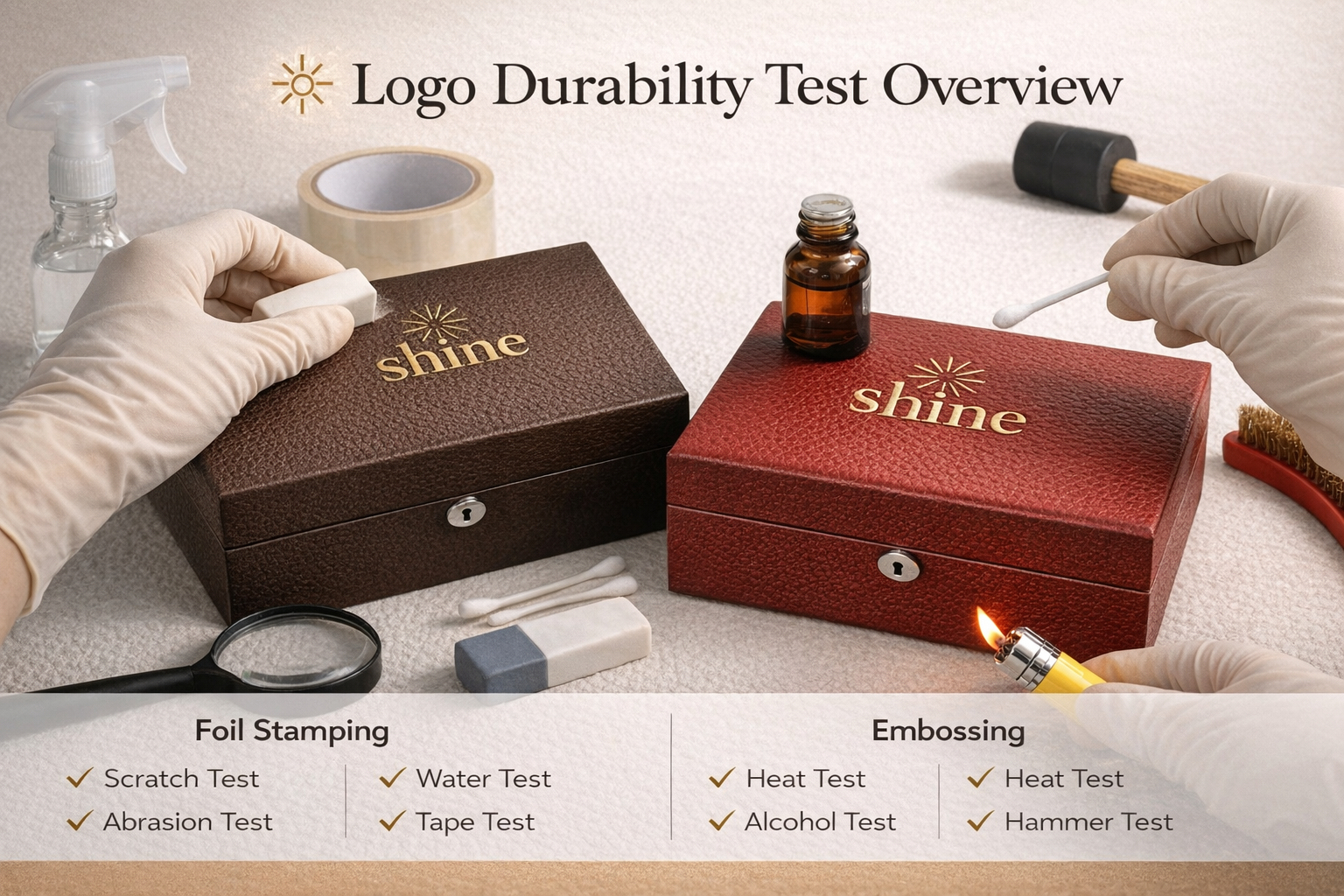
Why Logo Durability Testing Matters
- Real handling is harsh: retail counters, customer touch, stacking, and unboxing friction.
- Logos fail differently: rub-off, edge lifting, cracking on folds, surface scuffing, or plate misalignment.
- Most issues show up late: after shipping, display, or repeated handling — when fixing is expensive.
TL;DR — Fast Durability Checklist
- Silk screen / UV printing: prioritize rub resistance and edge handling checks.
- Foil stamping: confirm adhesion on the target material, especially near edges/folds.
- Emboss/deboss: generally durable; check surface scuffing and “edge whitening” on some papers.
- Metal plates: confirm bonding strength, alignment, and scratch resistance.
- Always: validate on a PPS sample before mass production.
Core Test Methods (Practical, B2B-Friendly)
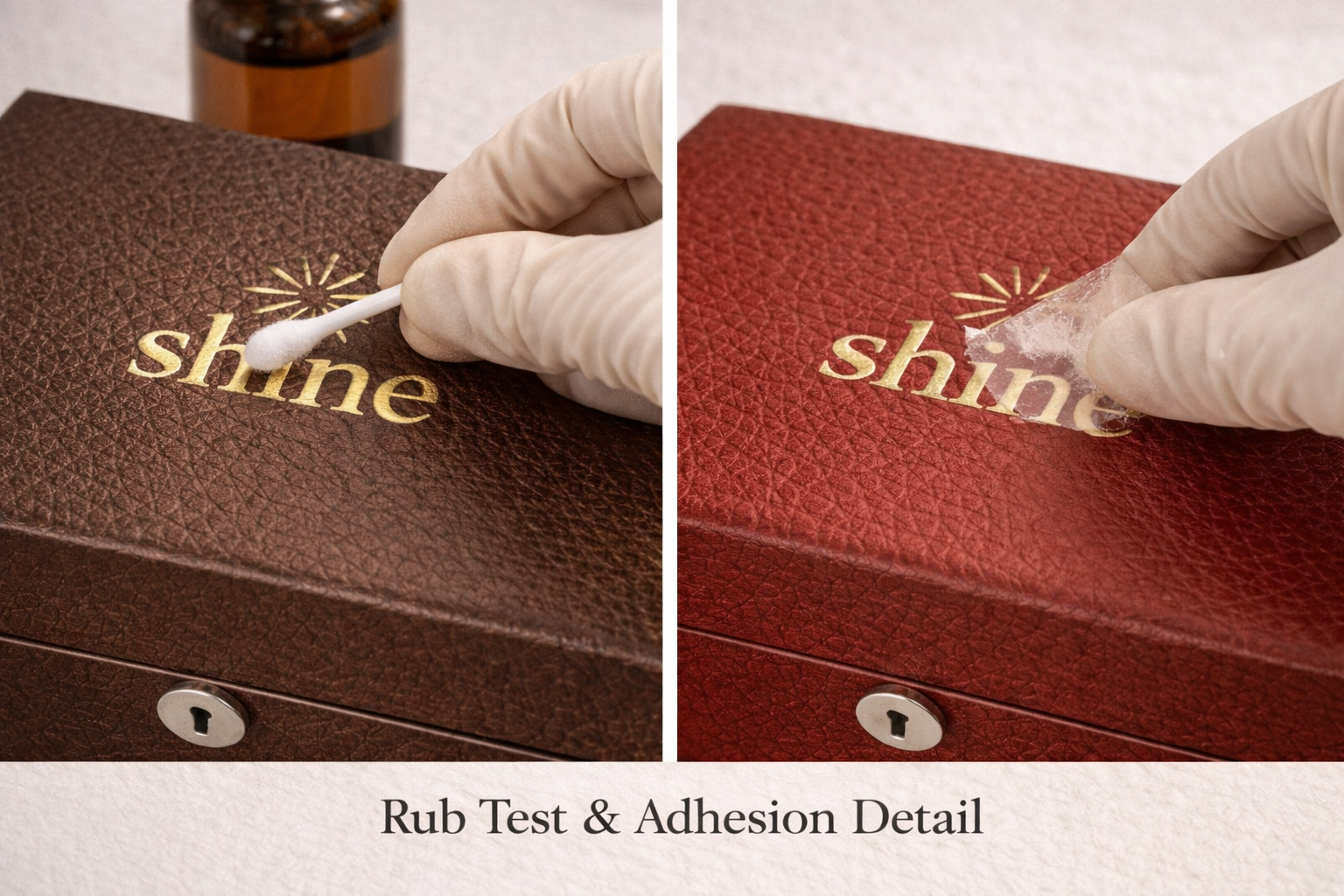
Rub Test (Retail Handling Simulation)
This test checks whether the logo finish wears off when rubbed repeatedly — simulating real retail handling and stacking.
- Most critical for silk screen and some UV printed logos
- Useful for forecasting how packaging looks after repeated customer touch
Adhesion Check (Foil / Plates / Coatings)
Adhesion checks confirm that foil, coatings, or plates are firmly bonded to the box surface, especially on textured or soft-touch materials.
- Important for foil stamping (especially on textured paper)
- Essential for metal logo plates (bonding strength + alignment)
Heat & Handling Checks (Logistics Reality)
Shipping and storage can expose logos to heat, moisture, and compression. Basic environmental checks help confirm the finish stays intact during real logistics.
- Heat exposure: checks lifting, discoloration, or softening
- Edge/fold stress: checks cracking on corners and bends
- Packaging friction: checks scuffing from stacking and inserts
Test Priority by Finish Type
| Finish Type | Highest Priority Tests | Common Failure Points | Best Practice |
|---|---|---|---|
| Hot Foil Stamping | Adhesion check, edge/fold handling | Edge lifting, thin line break on heavy texture | Confirm on target paper + approve PPS sample |
| Emboss / Deboss | Handling scuff check | Surface scuffing, edge whitening on some wraps | Pair with suitable wrap/coating for retail programs |
| UV Printing | Rub resistance, edge/fold cracking check | Gloss looks plastic, cracking near folds | Spot UV often looks more premium than full gloss |
| Silk Screen | Rub resistance (most important) | Ink wear in high-touch zones | Confirm rub resistance for wholesale/retail handling |
| Metal Logo Plate | Bonding strength, scratch/scuff check | Plate shift, bonding weakness, scratches | Confirm bonding + alignment during PPS |
How to Specify Durability in Your RFQ
- Box type & structure: ring/earring/necklace set, lid style, edges/folds
- Target material: paper wrap / textured paper / leatherette / velvet / wood
- Logo finish target: foil / emboss / deboss / UV / screen / plate
- Handling scenario: direct-to-consumer vs retail counter vs wholesale program
- Artwork: vector preferred (AI/EPS/PDF)
FAQ
Which logo finish is most durable for jewelry boxes?
Embossing/debossing is highly durable because there is no applied layer to rub off. Foil stamping performs well when properly bonded and tested, while metal logo plates require strong adhesion validation.
What tests matter most for wholesale and retail handling?
Rub tests and adhesion tests are the most practical for predicting how packaging looks after repeated handling, stacking, and shipping.
When should durability testing be confirmed in production?
Confirm durability during PPS sampling, before mass production.
Need a Logo Finish That Holds Up in Retail?
Use our finish guide to choose the right method by material, durability, and premium presentation.
Read the Finish GuideRelated: Logo Options · Materials & Craft · Request a Quote