

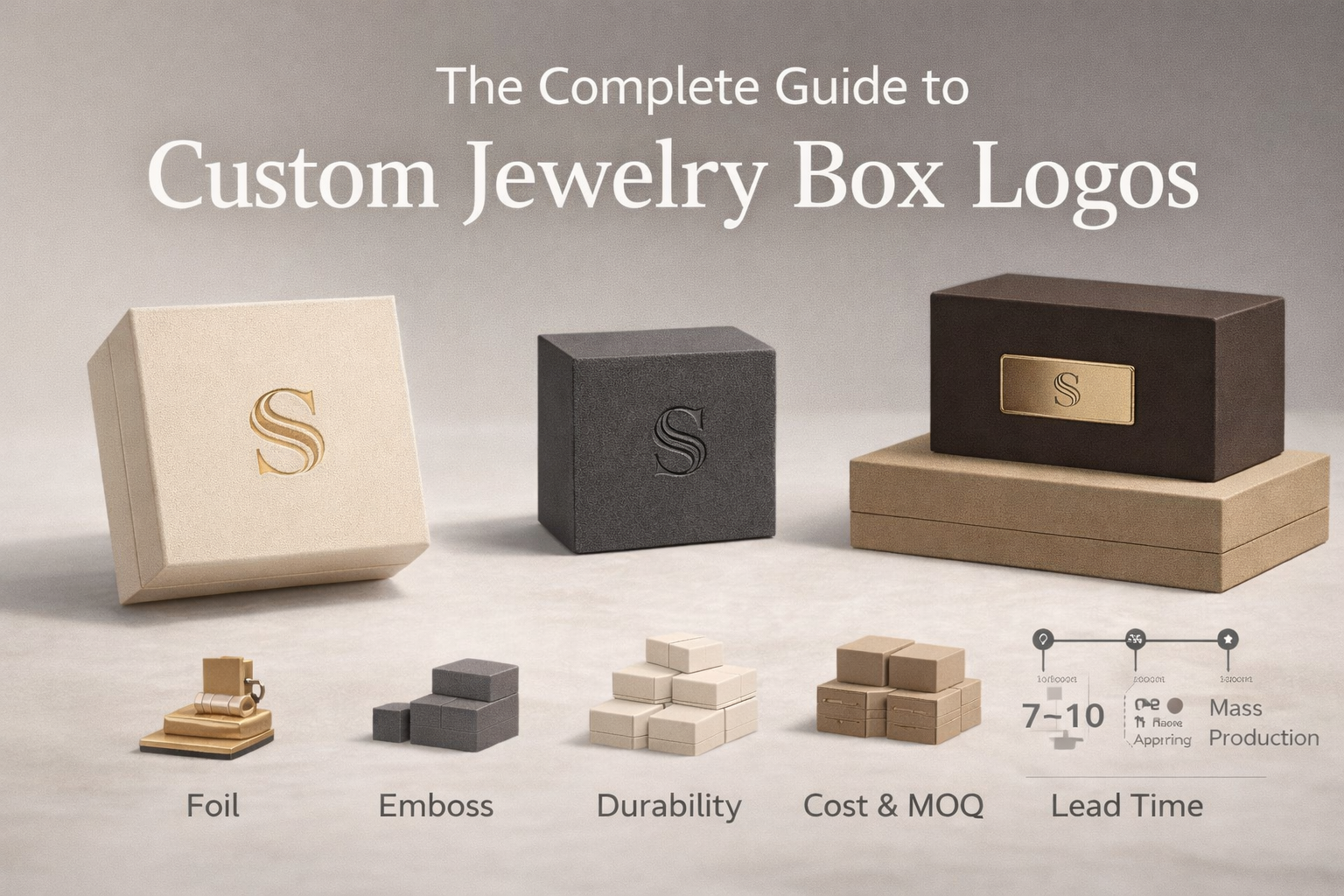
The Complete Guide to Custom Jewelry Box Logos
A practical B2B guide to logo finishes, materials, durability, MOQ, lead time, and how to choose the right branding method for premium jewelry packaging.
Your logo is often the first brand element customers notice on a jewelry box. It affects perceived value, shelf presence, gift appeal, and whether the packaging feels consistent enough for long-term reorders.
But the right logo solution depends on more than “gold looks premium.” For B2B buyers, the real decision involves finish method, surface compatibility, durability in handling, and whether the chosen look can be repeated efficiently across bulk programs.
This pillar guide brings everything together in one place. If you are planning custom jewelry packaging for a brand, retailer, gift collection, or wholesale program, this page will help you choose faster and reduce avoidable sampling delays.
On this page
TL;DR — Fast Recommendations
- Classic premium look: start with foil stamping, especially gold or champagne gold.
- Quiet luxury / minimalist brands: choose embossing or debossing for a more subtle, design-led effect.
- High-end signature SKU: deboss + foil is one of the best “depth + visibility” combinations.
- Retail handling concern: review logo durability testing before mass production.
- Planning cost and timeline: see logo cost, MOQ & lead time for a practical B2B decision path.
Why Custom Jewelry Box Logos Matter
A jewelry box logo is not just decoration. It performs four jobs at once:
- Brand recognition: the box becomes a branded touchpoint, not generic packaging.
- Premium signal: the finish quality influences how expensive the product feels before the box is even opened.
- Consistency across reorders: stable logo execution supports wholesale, gifting, and retail programs.
- Content and photography value: a well-finished logo improves product photography, unboxing videos, and brand presentation.
Main Logo Finish Options for Jewelry Boxes
Most custom jewelry packaging projects start from one of these finish families:
| Finish Method | Best For | Main Strength | Watch-out |
|---|---|---|---|
| Foil Stamping | Classic luxury, strong visual branding | High contrast and instant premium recognition | Needs material-compatible adhesion, especially on textured wraps |
| Emboss / Deboss | Minimalist, quiet luxury brands | Depth without shine; no applied layer to wear off | Effect depends on lighting and surface softness |
| UV Printing | Fine detail, gradients, modern visuals | Multi-color and small detail support | Over-gloss can look less premium if uncontrolled |
| Silk Screen | Cost-conscious wholesale programs | Practical and scalable for large runs | Less “luxury” than foil or emboss |
| Metal Logo Plate | Collector, gifting, ultra-premium lines | Strongest badge-like perceived value | Extra tooling/assembly and bonding checks required |
Where to Go Deeper
Choose the Logo Finish by Material
Material compatibility is one of the most overlooked factors in jewelry packaging. The same logo artwork can look crisp on one surface and problematic on another.
| Material | Recommended Finishes | Why It Works |
|---|---|---|
| Paper wrap / textured paper | Foil, emboss/deboss, screen | Good for premium branding, but texture depth affects line sharpness. |
| Soft-touch paper | Deboss, emboss, foil | Ideal for quiet luxury and refined tactile presentation. |
| Leatherette / PU | Emboss/deboss, some foil, UV | Emboss often feels integrated; foil depends on surface compatibility. |
| Velvet / fabric | Screen, plate, tag-based solutions | Foil is not always the best match on soft fabric surfaces. |
| Wood / rigid box surfaces | Metal plate, print, selected emboss routes | High perceived value but usually needs stronger bonding/QC checks. |
For a broader surface overview, see Materials & Craft.
Durability and Testing: What B2B Buyers Should Check
Luxury presentation is only part of the equation. A logo that looks good in sampling but fails after shipping or retail handling will create avoidable complaints.
Rub Resistance
Important for screen and some UV applications. It helps forecast whether repeated customer touch will degrade the mark.
Adhesion Check
Critical for foil and metal plates, especially on textured, coated, or soft-touch materials.
For the practical testing breakdown, read Logo Durability Testing for Custom Jewelry Boxes.
Logo Cost, MOQ & Lead Time: What to Expect
Cost is shaped by the finish method, tooling, material compatibility, artwork complexity, and whether the SKU is stable enough for efficient repeat production.
- MOQ logic: driven by structure, finish, material, and production efficiency.
- Hand sample: typically 7–10 days after specs confirmed, with photo/video confirmation available.
- Mass production: typically 20–30 days after PPS approval.
- Trade terms: EXW / FOB / CIF depending on project scope.
For the full breakdown, see Custom Jewelry Box Logo Cost, MOQ & Lead Time Explained.
Related Resources for This Topic Cluster
How to Choose the Right Logo Finish · Foil Stamping vs Embossing · Logo Durability Testing · Logo Cost, MOQ & Lead Time
Choose the Right Finish
Compare foil, emboss, deboss, UV, and metal plates by brand style, material, and premium presentation.
Plan for Cost & Lead Time
Understand logo cost drivers, MOQ logic, sample timing, and production planning for bulk orders.
RFQ Checklist: What to Send for a Faster Proposal
To reduce delays and avoid unnecessary revision loops, send these details with your inquiry:
- Box type: ring / earring / necklace / set box
- Target size: L × W × H or a reference sample
- Quantity: current order + expected reorder scale
- Material: paper wrap / velvet / leatherette / wood
- Logo finish preference: foil / emboss / deboss / UV / screen / metal plate
- Insert requirements: slot layout, pillows, compartments, lining
- Artwork: vector preferred (AI / EPS / PDF)
- Target delivery window: preferred shipment timing
FAQ
What is the best logo finish for luxury jewelry boxes?
For many premium programs, foil stamping is the safest luxury baseline because it is highly visible and easy to recognize. For quieter luxury positioning, embossing or debossing is often the better choice.
Which logo method is most durable?
Embossing/debossing is inherently durable because there is no applied layer to rub off. Foil stamping is also durable when properly bonded and confirmed on the target surface.
Can I use different finishes for different SKUs?
Yes. Many brands use foil for core SKUs and reserve deboss, metal plates, or special combinations for limited editions, gifting, or higher-margin collections.
How long does sampling and production usually take?
Hand sample is typically 7–10 days after specs are confirmed. Mass production is typically 20–30 days after PPS approval.
Where should I start if I am still comparing finishes?
Start with the finish selection guide, then review durability and cost or MOQ pages. That gives you the fastest decision path from visual style to production planning.
Need Help Choosing the Right Logo Method?
Share your box type, material, quantity, and preferred finish. We’ll propose a practical branding solution built for premium presentation and bulk consistency.
Request a QuoteContinue reading: Finish Guide · Foil vs Emboss · Cost, MOQ & Lead Time